| St Andrew’s Burial Ground,
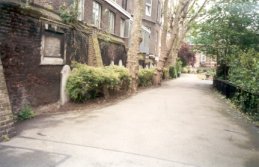
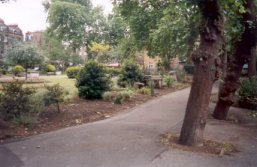
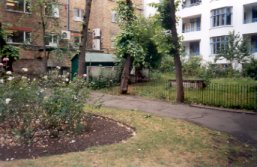
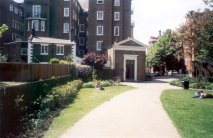
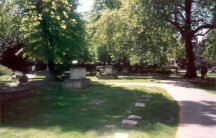
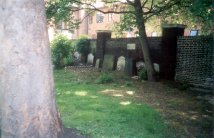
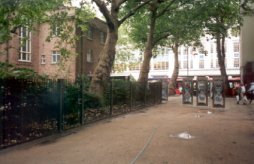
Gray's Inn Road. An attractive ground, with more gravestones left in situ than usual and flower beds instead of too much easy to mow grass. There is evidence of extensive subsidence here, with sinking paths and lopsided gravestones. The church has gone, and has been replaced by a startlingly white and modern apartment block. Presumably the row of adjacent buildings were built in the burial ground at some point after it was closed. The part south of where the church used to be is still quite untidy (see Holmes below) though the lumber has gone. In 1819 a Mr Gilbert tried to have his wife buried in this ground in an iron coffin, as he had 'a great dread that her remains might be despoiled'. The authorities demanded a special fee of £10. Mr Gilbert wouldn't pay. In June of that year there was a 'disgraceful riot and disturbance' at the ground when an attempt was made to bury Mrs.Gilbert, the upshot of which being that Mr Bridgeman, the patentee of the iron coffin, was hauled off to the compter on a charge of assault. (He had upset the sexton by suggesting that he didn't like iron coffins because he couldn't get the bodies out, but who hit whom first was never established) After much argument with the ecclesiastical authorities Mr Gilbert presented a petition to parliament, which was ignored. In 1820 it came before the Consistory court. Deliberations took five months. Eventually it was held that iron coffins, being durable, required a longer lease of the ground, and thus a higher fee was justified. However, Mr Gilbert got his way on a legal technicality, and in November 1820 Mrs Gilbert, who had spent over a year and a half in the St Andrew's bone-house, was finally laid to rest. 1¼ acres. This ground belongs to the parish of St. Andrew, Holborn, adjoins the church of Holy Trinity, and is maintained as a public garden by the St. Pancras Vestry. It is well kept, except a railed-off piece south of the church, which is a sort of lumber-room. (Holmes) |
|
|
|
|
|
|
|
| The Burial-ground of St. George's,
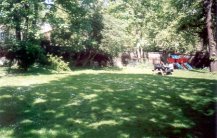
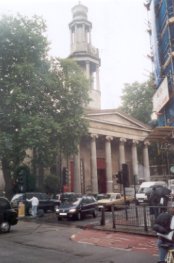
Bloomsbury. The Burial-ground of St. George the Martyr, Bloomsbury. Well maintained public garden. To the south, there is a walled-off area attached to the Coram family centre. This is used as a playground. These are out of Wakefield Street, Gray's Inn Road, and together form one public garden maintained by the St. Pancras Vestry, and very well kept. A part of the latter, which was consecrated in 1714 is still closed. Each ground is 1¼ acres in extent. There are vaults under the church in Hart Street. (Holmes) |
|
|
|
|
|
|
|
|
Walled off area attached to Coram Centre |
|
Whitfield's Tabernacle Burial-ground, Tottenham Court Road. |
|
|
|
|
|
|
|
|
Vault: St. Pancras New Church. Opened 1822. |
|
|
|
|
|
Vault: Foundling Chapel. Built around 1745 and associated with Handel Chapel demolished c. 1920. No information on how many burials there were in the vault, though Coram was buried there. His monument was moved to St Andrew's Holborn, though it is not clear what happened to Coram. Possible vault St Peter's Regent Square Built 1822-4. Bombed during the war and demolished. |
|