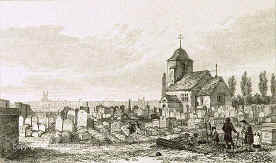
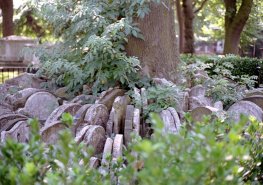
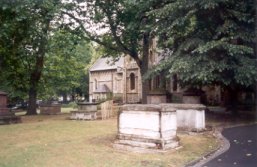
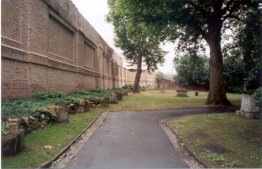
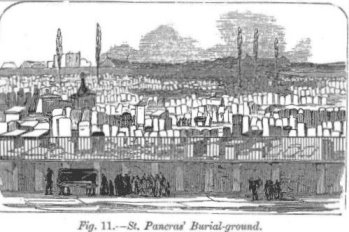
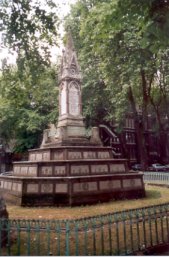
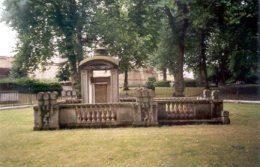
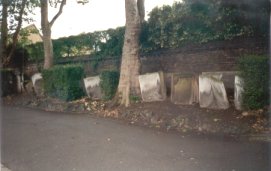
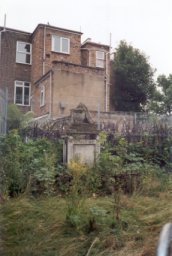
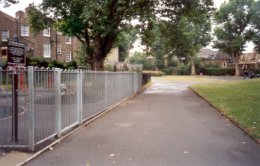
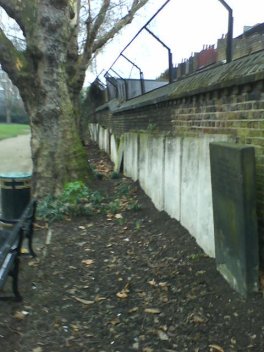
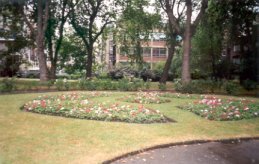
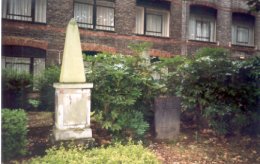
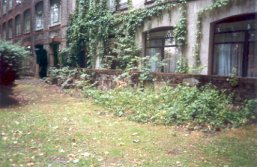
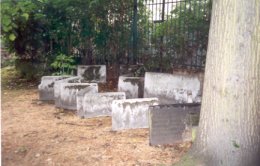
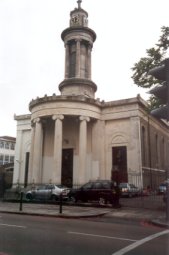
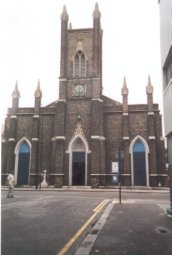
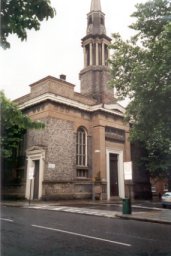
St. Pancras Burial-ground, Pancras Road. St. Giles in the Fields Burial-ground, Pancras Road. All one open space, though it is fairly clear which part was which. The St Giles additional ground was opened in the 1780s, though not much loved by the parishioners, one of whom prepared this little speech for the churchwardens: 'As I have a mind to be exact, I have penned down my sentiments on this here bit of paper: I object to the burying-ground that is offered to this parish, for this reason, Mr Churchwarden, that I am sure that no man in his senses would go so far to be buried: In the next place, Mr Church-warden, I am told (for I know nothing but what I am told) that it is so improper a place for a burying-ground, that before a man can lay his head down in the ground, Mr Church-warden, he will certainly be drowned with water.' ( The Times, March 8th 1780) Now further reduced as part has been taken recently for widening the railway into St. Pancras for Eurostar trains - it is now behind a forbidding wall. Otherwise still very much as described by Mrs Holmes below - an oasis in a busy part of London, with rather more gravestones than is usual these days still in situ. The 'dome' has a display panel giving information on the ground's links with Thomas Hardy, who in his architectural days supervised the exhumations and reshaping of the ground when the original Midland Railway railway was built in 1866. (Mrs Holmes date given below is incorrect.) It's interesting to speculate on what effect this rather gruesome and unpleasant task had on his later writing - there are certainly echoes in many of the poems: O passenger, pray list and catch Our sighs and piteous groans, Half stifled in this jumbled patch Of wrenched memorial stones! We late lamented, resting here Are mixed to human jam And each to each exclaims in fear I know not which I am! (The levelled Churchyard)
|
|||||
|
|
|
||||
|
|
|
||||
|
|
|||||
|
|
|
||||
| St Martin’s in the Fields Burial-ground
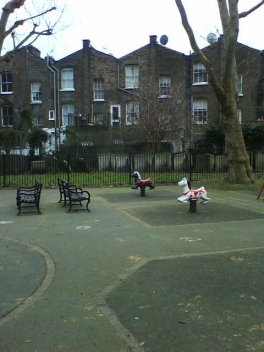
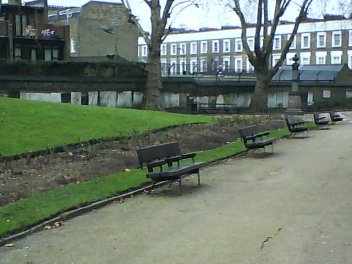
in Pratt Street. Ground purchased by St Martin in the Fields in 1805. In use until 1856, at first for St Martin's parishioners (mainly the poor) then later for other parishes. Now a not especially exciting open space, with gravestones around the edge. To the south these have been arranged in a rather odd herring-bone pattern for no obvious reason. Over 18,000 burials recorded at the site. 1¾ acres. This was consecrated in 1805; It is now a well-kept public garden under the control of the St. Pancras Vestry. A part appears to have been appropriated as a private garden for the almshouses and as a site for a chapel and other buildings. (Holmes) On Saturday morning, about 4 o’clock, a party of resurrection men scaled the walls of St Martin’s burying-ground situated in the fields at the back of Camden-town, for the purpose, as it is supposed, of stealing the body of a grenadier nearly 7 feet high, who had died in the poor-house of that parish, and had been buried in the above mentioned place of interment. The sexton, to guard the ground, had, more ingeniously than lawfully, put together a number of gun-barrels so as to form a magazine, that they might all be discharged together. After burying the bodies of the paupers, he made it a practice to direct the muzzle of this formidable engine towards the mound of earth which was the general receptacle for the dead parochial poor, and having a string fixed to the trigger, he fastened the other end of it round a large piece of wood, which he buried in the grave about a foot below the surface of the ground, so that if anyone should attempt to dig, they must necessarily remove the above piece of wood, the string would pull the trigger, and a volley of bullets would immediately sweep that quarter of the burying ground. On the morning in question, about half past 4, he heard a tremendous report, and concluding it was his new piece of ordnance, he went out as soon as possible, and on arriving at the guarded spot, he found some spades, shovels, pick-axes, and other resurrection paraphernalia. Among other things he found a man’s hat, through one side of which a bullet had evidently passed; but from there being no track on the other side of it, it is concluded that the bullet had lodged in the head of the owner and killed him, and that he had been carried off by his associates. (The Times, Jan 29, 1817) |
|||||
|
|
|
|
|||
|
|
|
|
|||
|
Thanks to Sophie Marton for the lower three pictures |
|||||
| St. James’s Burial-ground,
Hampstead Road. In use from around 1780 - 1853 as an extra-parochial ground for St James Piccadilly. Quite an extensive area, now with tennis courts and a children's playground. Rather gloomy. Gravestones around the edge, some in the herringbone pattern described above - a speciality of this part of the London Borough of Camden. The improvements mentioned by Holmes were the resiting of Cardington Street, probably due to the enlargement of Euston Station, during the 1870s or 80s. This belongs to the parish of St. James, Piccadilly. It was laid out as a public garden in 1887, and is maintained by the St. Pancras Vestry, a large slice at the east end having been taken off for public improvements. The remaining portion measures about 3 acres. |
|||||
|
|
|
||||
|
|
|
||||
| St James Cemetery,
Highgate. One of the 'Big Seven' cemeteries, well known as the burial place of Karl Marx and a major tourist attraction. The links page has a link to the Highgate cemetery website. 38 acres. First used in 1839. In 50 years 76,000 interments had taken place. It is in two portions and situated on a steep slope. Open daily. (Holmes) |
|||||
|
Vault: Camden Chapel Anglican. Built 1824. originally Camden Chapel, associated with the burial ground in Pratt Street. It became All Saints, with it's own parish, in 1852. In 1948 it became All Saints Greek Orthodox Cathedral. It is well maintained. The fate of the vault burial not known. |
|||||
|
|
|||||
|
Possible vaults: St Mary's Eversholt St (St Mary's Somers Town) Built 1822-4 Still standing - an early gothic revival church rather sneered at by architectural historians. Vaults unlikely. |
|||||
|
Christchurch Albany Street Consecrated 1837. Now Antiochan Orthodox Church named St George's Cathedral. Somewhat dilapidated. |
|||||
|
|
|
||||
|
St Michael's Highgate Built 1831-2 on the site of the old Grammar school chapel dating from the 16th c. Extensive burial records from 1603. Kentish Town Church Highgate Rd. Dedication St John the Baptist. Built 1783, rebuilt 1843-5. No longer in use. Click here for a note on church and vault burials. |
|||||